
Well unfortunately our Journey is at a end with day 25 but I hope you made it all the way though and you’re standing enough to talk about it. If you are, today’s bottle should help you deal with what ever you have gotten yourself into and at 20cl there is enough of it that if you feel the need you can share and not feel like you’re losing out.
JURA DISTILLERY
ISLANDS SINGLE MALT SCOTCH WHISKY
Inside, Jura is a classic 1960s distillery – large rooms, a clear flow from a semi-lauter tun, stainless steel washbacks, and a capacious stillhouse with very tall (7.7m) stills with capacity in excess of 20,00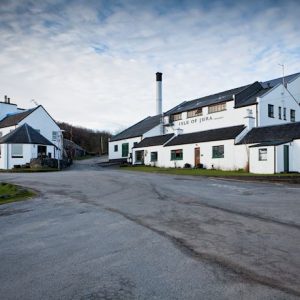 0 litres. Clearly it was not built solely to satisfy the thirst of the local populace. Relatively short ferments give Jura’s background rigidity – meaning that this is a whisky that needs time (or active casks) to open fully.
Whyte & Mackay’s master blender Richard Paterson is a great advocate of ex-Sherry casks and while the bulk of Jura is aged in ex-Bourbon and refill, in terms of single malt bottlings the Sherried element has a higher presence, adding some dried fruit sweetness.
Peated malt began to be run for a small period annually from the late 1990s onwards. This is blended with unpeated in some expressions, as well as on its own.
JURA HISTORY
Although the large southern Hebridean island of Jura has always been sparsely populated, it has a fascinating distilling heritage. It was on 18th century Jura where it was reported that the natives made spirit from rowan berries, as well as using the bitter fruit to acidulate their whisky punch.
Illicit distillation took place, but there was a legal site in the island’s only settlement, Craighouse, in 1810 licensed to the island’s owner Archibald Campbell. There is debate as to whether there was a legal distillery in Lagg.
The distillery went through a number of names: Craighouse, Small Isles, Caol nan Eilean, Jura, and owners without garnering any great fame until 1901 when it was among many to close in whisky’s first great sales slump. The cost in running a remote island site is always expensive and a lack of direct transport to the mainland [all ferry traffic still has to go via Islay] also counted against its survival.
It was these economics which ruled Jura out of the distilling equation for over six decades. Then, in 1963, two of the island’s landowners, Robin Fletcher and Tony Riley-Smith, decided to start whisky-making once more – predominantly as an incentive to stop any further decline in the island’s population. With financial backing from Leith-based blenders Charles Mackinlay & Co., the famous designer William Delme-Evans was hired and a large, modern distillery was built which was further expanded in 1978 to its current size. In 1985, Invergordon Distillers bought Mackinlays and from there the firms were folded into Whyte & Mackay.
It began being sold as single malt in 1974, and the range has grown steadily since. The start of peating saw some smoky whisky being included in the no-age Superstition brand, launched in 2002, while a 100% smoked Prophecy was released in 2009.
Tasting Notes

Nose: grapefruit, Mildly sherried, as befits the finish. If there’s any Island peat present, it’s in the form of a soft, ferny, heathery aroma in the distance. The fruit is fresh and bright, and backed up by a capable maltiness with breakfast cereal and spongecake. Soft, lovely, and floral. Very nice.
Taste: Slightly chewy texture, and quite sweet. Candied orange peels, tawny fudge, blanched almonds, and marzipan. Not an ounce of burn on the tongue. Ladylike, even.
Finish: The heather notes return, with honey and a bit of oaky tannins. A final wave of very mild citrus – just pith, maybe – and a ghost of bitterness.