
Welcome to day 20. When you think of whisky from Islay you generally think of peat and smoke but Bunnahabhain has taken a different approach from its many counterparts on Islay, championing itself as “the gentle taste of Islay,” boasting what they say is a “dram that embodies the island’s more approachable side.” I think you will agree they did good.
BUNNAHABHAIN DISTILLERY
ISLAY SINGLE MALT SCOTCH WHISKY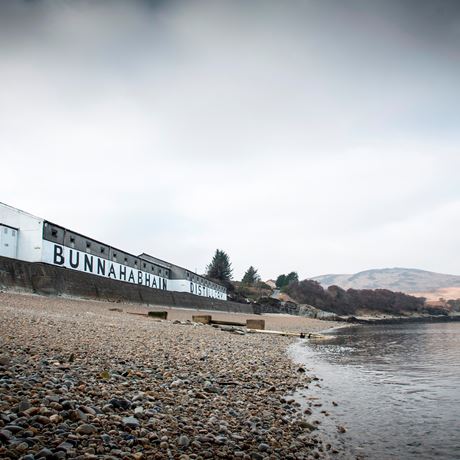
Everything about it is large, from the huge courtyard to the stills. It is these with their low fill levels and massive amount of available copper which help to craft what has always been a light style of malt. Ageing has traditionally been in ex-Sherry casks which adds a sumptuous sweet richness to the spirit though quite where the spicy ginger note, which is a marker for Bunna’, comes from is unclear. Occasionally refill casks show an almost salty edge.
Although peat levels had dropped to virtually nothing from the 1960s onwards, Bunna’ did start life smokier than it is now, something which Burn Stewart is reviving. These days, around 20% of production is heavily peated, destined for a variety of bottlings, the main one being Toiteach.
BUNNAHABHAIN HISTORY
Islay’s remote north east coast might seem a strange place to find a substantial Victorian distillery, but it was chosen in 1881 by William Robertson (of Robertson & Baxter) in partnership with Greenlees Bros. as the perfect spot for his island vision. Constructing it meant not only building the distillery but houses as well, putting in a road, and adding on a pier so that casks and barley could come in, and whisky go out. It cost Robertson £30,000 (£2.6m in today’s money). In 1887, when Bunnahabhain merged with Glenrothes, Highland Distillers [now Edrington] was formed.
While other Islay distilleries sold their make as single malts and for blending, Bunna’s destiny was always with the latter. While it was used across the industry, it performed a central role in three R&B blends: Famous Grouse, Cutty Sark and, in time, Black Bottle.
Rapid growth for Scotch in the early 1960s saw the stills being doubled in 1963, the same year as the floor maltings came out. Its good fortunes weren’t to last and like many distilleries it was mothballed in 1982. Although this only lasted two years, production levels were kept low for many years. By the end of the 1980s it was finally ready to emerge as a single malt with the tag-line ‘the unpronounceable malt’. The vast bulk of its make was however still making its way into blends.
Despite an upturn in the whisky market, Edrington sold it (while retaining fillings contracts) in 2003 to Burn Stewart for £10m. Burn Stewart itself was owned by Trinidad-based conglomerate CL Financial which went spectacularly bust in 2009. In 2013 CL’s receivers sold Burn Stewart to its long-term South African distributor, Distell. Since then production levels have increased as have sales of the single malt – with significant success in Africa and Taiwan.
Tasting Notes
Nose: apple pie filling,butter, apples,black olives,fresh laundry,licorice,vanilla,port,stewed apples
Taste: licorice,vanilla,port,oily,cooked apples
Finish: mead,peat,mild finish with a burns that comes back,soft fruit,apples,pears,brine,licorice