Day 23 — Compass Box Peat Monster

Day 23 is a classic for all you peat heads. I do not have much more to say about this guy please enjoy

Story

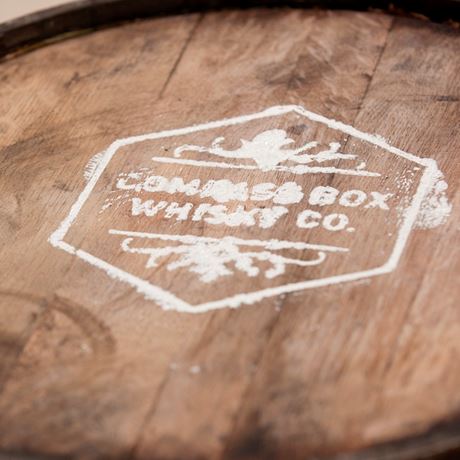
Compass Box Whisky Company is headed by founder and whisky-maker John Glaser, who spent many years working in the wine trade before moving into Scotch whisky and a role as marketing director for Johnnie Walker.

As the company puts it, he established Compass Box Whisky “…based on his commitment to evolving practices in the industry to make great Scotch whisky more approachable and relevant to more people.”

Unsurprisingly, given his wine background, Glaser has a deep commitment to wood quality when it comes to maturation, and at times he has pushed the boundaries of conventional whisky wisdom. For example, he created the first commercial blended grain Scotch whisky, named Hedonism, and Spice Tree, which fell foul of the Scotch Whisky Association (SWA) for its use of suspending staves of toasted French oak within conventional casks.

Compass Box offers a ‘Signature Range, which comprises The Spice Tree, The Peat Monster, Oak Cross, Asyla and Hedonism. Meanwhile, the company’s ‘Limited Range’ offers limited edition whiskies
Image

such as Hedonism Quindecimus and Flaming Heart. Compass Box’s third range is Great King Street – blended Scotch with 50% malt content, which also bears the company’s trademark transparency about component whiskies and maturation regimes.

History

Compass Box Whisky was established by John Glaser in 2000, and its first commercial release was the blended grain Hedonism, offered the same year. Peat Monster – originally just The Monster – was launched four years later, comprising heavily-peated Islay and medium-peated Highland malts, which went on to become the company’s best-seller.

The original version of The Spice Tree blended malt was marketed in 2005, but withdrawn the following year, being replaced by a variant with heavily-toasted cask heads instead of the staves disapproved of by the SWA. The Great King Street range of blended Scotch whiskies was inaugurated with Great King Street Artist’s Blend in 2011, followed by Glasgow Blend in 2014.

In April 2015, Bermuda-based Bacardi became a minority shareholder in Compass Box Whisky, having established a relationship with the company through a supply contract for component whiskies.


Image result for compass box peat monster

Tasting Notes

Nose:Peat, marked salinity, leans to Caol Ila in style, something medicinal. Sweet and fruity, grainy.
Taste: Peat, oak. Botanicals, floral, coppery, sweet, smoky bacon, hint of papaya.
FInish: A lingering sweetness, more peat, floral: roses and violets, sweet spice, oak.

Purchase Links

Can be purchased from Strathcona liquor store

Day 22 — Glengoyne 15

Day 22. The end is rapidly approaching but that dose not mean that the tasty hits are not still rolling. Dig in and enjoy

GLENGOYNE DISTILLERY

HIGHLAND SINGLE MALT SCOTCH WHISKY

It runs a combination of long (and very long) fermentations, while distillation in its three stills (one wash, two spirit) is extremely slow. All of the stills have boil bulbs, which increases the amount of copper availability, while the gentle heating of the wash and spirit also helps to maximise the amount of time the alcohol vapour can play with the copper. This maximising of reflux produces a gentle, sweet, and fruity new make.

There is however sufficient weight in the spirit to be able to balance with maturation in ex-Sherry butts – a signature of Edrington’s distilleries – which has been retained by Ian MacLeod.

History

A distillery has stood on this site since 1833, when the Edmonstone family (the main landowner of the area) began production, passing control to the MacLelland family in the 1850s who, in turn, sold it to the Glasgow-based blender Lang Bros in 1876. It was they who changed the distillery’s original name, Burnfoot, to Glen Guin which was anglicised to Glengoyne in 1905.

It played a vital role within Lang Brothers’ blends [the best known being Supreme] and those of Robertson & Baxter (now Edrington). The latter firm bought Lang Brothers. in 1965.

Single malt bottlings began in the early 1990s, when Glengoyne was sold as ‘the unpeated malt’, while much was also made of the fact that, geographically, the distillery is in the Highlands while its warehouses, directly across the road, are in the Lowlands.

Edrington considered it surplus to its requirements in 2003, selling it to Ian MacLeod for £7.2m. Its new owner has subsequently (and successfully) focused on developing the brand as a single malt and the distillery as a multifunctional tourist destination. It now gets in excess of 50,000 visitors a year.

Image result for Glengoyne 15

Tasting Notes

Nose: some earthy tones, wet leaves and malt with vanilla and some dried dark fruits; cinnamon infused chocolates and candied orange with some floral notes.

Taste: very creamy, soft and floral with loads of spices, some tobacco and chocolates; leathery with soft malt and candied orange.
FInish: long and leathery with fading vanilla, orange and clove.

Purchase Links

Can be purchased at Tudor house

Day 21 — Connemara

Day 21. Since we had Irish whisky yesterday why not continue with that. Today we have the biggest peatest Irish offering if you have never had it before enjoy for those of you that have had it before I am sure you will agree that its tasty stuff

Story

Cooley Distillery is nestled in the foothills of the Cooley Mountains in Co. Louth. The Cooley Distillery enjoys a perfect location for a whiskey distillery due to its access to clean, pure water from the Slieve na gCloc river that runs down from the mountain and right by the distillery.

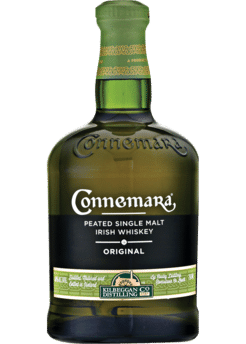
Both patent and pot stills are used here at Cooley allowing us to produce both malt and grain whiskey, reinvigorating old famous brands such as Kilbeggan® and Tyrconnell while also allowing us to create new brands such as Connemara Peated Single Malt and Greenore Single Grain Irish whiskey.

Image result for kilbeggan historyHistory

The distillery was founded in 1757 and, by 1798, was in the hands of Matthias McManus, whose son was executed in Mullingar due to the part he played in the United Irishmen rebellion of that year.

John Locke took over the distillery in 1843, and it passed down to his granddaughters Mary Evelyn and Florence Emily in 1943. The economic depression of the 1920s and 1930s took its toll on Locke’s. In 1947 it was put up for sale and the successful bidder, the Transworld Trust, involved fraudsters from Switzerland and Austria. Oliver J. Flanagan alleged under Oireachtas privilege that Fianna Fáil politicians were linked to the deal; a tribunal of inquiry discounted the allegations but the damage contributed to Fianna Fáil’s defeat in the 1948 election. On 19 March 1954 production ceased at the distillery. It closed completely in 1957 and the building began to fall into disrepair. Twenty five years after its closure, the community of Kilbeggan restored the distillery and opened it to the public as a whiskey distillery museum. Cooley Distillery bought the license to produce Kilbeggan and Lockes Whiskey, and later took over the museum along with opening a new working distillery in Kilbeggan.


Image result for connemara whisky

Tasting Notes

Nose: Well-smoked and peated, heather freshness and floral notes with a honeyed sweetness and a little wood.

Taste: Full and smooth with notes of malt and peat, honeyed smoke and barley sweetness.
FInish: Long and pungent with honey and peat smoke.

Purchase Links

Can be purchased from Tudor House

or

Can be purchased at Strathcona Liquor Store

Day 20 — Writers Tears

Welcome to day 20. Today we have one of my favourite go to bottles I think it is a fine whiskey, which strictly speaking is a blend but only contains pot still whiskey and malt whiskey. Writers Tears is a brand owned by the Walsh Whiskey Distillery, the same folks that are behind The Irishman line of whiskeys. This was produced at an undisclosed distillery. It is a blend of single-pot still and triple-distilled malt whiskeys and was aged in ex-bourbon casks. The vatting of the two types were done by Bernard Walsh. Please enjoy


Image result for writers tears

Tasting Notes

Nose: cooked apple, white chocolate, a touch of juicy malt
Taste: round, oily and coating; more cooked apple, under-cooked pie crust, dewy flowers; citrus, more white chocolate, Jujubes.
FInish: more white chocolate, almond croissants

Purchase Links

Can be purchased here from Legacy Liquor

or

Can be purchased here from BC Liquor Stores

Day 19 — Macaloney’s Colila & Bunahaben

Welcome to day 19. We got us another very peaty expression. All the way from Saanich.. well sort of. We have a blend from or very own  Victoria Caledonian Distillery where they have taken some very fine whisky and blended it together in im sure what can only be a very Canadian fashion. Today’s whisky is from their Macaloney guest whisky collection.

Story

There once was a wee Scottish lad by the name of Graeme Macaloney who found a summer job bottling whisky and fell in love with Uisge Beatha, the ‘water of life’. He dedicated his heart to finding a way to make whisky for a living, though circumstance would find a way of sidetracking his dreams.

Eventually, the winds of fate would blow the now grown Scotsman to the westernmost shores of Canada. Marveling in awe at the BC craft beer industry he saw an opportunity which he simply could not pass up –  making his own beer and whisky was within his grasp for the very first time.

Knowing he couldn’t create a world-class brewery and distillery on his own, Graeme assembled a skilled team of experts: the legendary Dr Jim Swan, the foremost whisky maturation expert in Scotland, Master Distiller Mike Nicolson, who has worked in over 18 renowned Scotch whisky distilleries, Kiwi Brew Master and renowned beer judge Dean McLeod, and dynamic Head Brewer Nicole MacLean who previously worked with BrewDog.
Only one problem remained: money! Without proper funding the Scotsman’s dreams would crash and burn before they ever really had a chance to take off. Searching for answers, he turned to the same whisky and craft beer community that originally inspired his efforts. To his astonishment, over 270 independent Canadian individuals came together to support his vision, become Founder-Owner-Investors, and turn their shared dream into a reality.

At the same time Graeme also explained to Agriculture & Agri-Food Canada that our distillery would upgrade a renewable commodity, Canadian barley to a super-premium single malt whisky for export to dozens of countries internationally. As a result they loaned us $2.4 million!

With everything in place, construction finally began on the Victoria Caledonian Distillery and Twa Dogs Brewery. When the first drops of new make spirit trickled out of the Forsyth’s Scottish pot stills, a chorus of joyous shouts was heard throughout the distillery. Needless to say, there was much revelry to be had that night.

 Image courtesy of  Victoria Caledonian Distillers .

Tasting Notes

Nose: oily, smoked meat, ashey, brine
Taste: smoked meat, ash, brine, vegetal peat, oily mouthfeel
FInish: long, smoky, peat

Purchase Links

Can be purchased from the Tutor house

or

Can be purchased from Strathcona Liquor Store

Day 18 — Shelterpoint Avant-Garde Barly Whisky

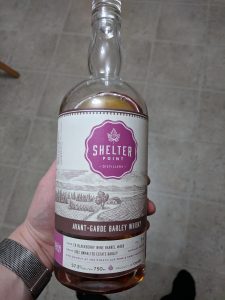
Day 18. Are you on day 18 of 18? if so super proud of you but even if your not I have our third of our super Canadian offerings and its another exclusive bottling. This one is distilled at Shelterpoint distillery in Campbell River right around the corner and then bottled for our very own Strathcona Liquor Store.

Story

Established in 2011, Shelter Point Distillery is located on 380 acres in Oyster River, BC, about halfway up the eastern coast of Vancouver Island. Farmed for generations, Shelter Point remains one of the last seaside farms on the Island. We are naturally blessed with the key ingredients of exceptional handcrafted artisanal spirits: fertile fields to grow our barley, a large underground aquifer to provide naturally filtered water and crisp sea air compliments of the Salish Sea. Add in our skilled craftspeople, traditional Scottish distilling methods and state-of-art facility, and the result is a world-class distillery on the West Coast of Canada.

History

The owner of Shelter Point Distillery is Patrick Evans, a third-generation farmer whose family members were turn of the 20th century pioneers in the Comox Valley. In 2005, Patrick and his family purchased what was once a research farm from the University of British Columbia, part of which was originally owned by his grandfather. The move allowed Patrick and his family to implement their “farmpreneur” vision – one where farming could coexist with wildlife, humans, farming and commerce. Together with Operations Manager James Marinus and a hand-picked team, Patrick has created products that have already placed Shelter Point Distillery on the world stage.


Tasting Notes

Nose: Jam, herbal, grapes
Taste:  Currants, blackberries, dark cherries, plums, chocolate, coffee
FInish:

Purchase Links

Can be purchased at Strathcona Liquor

Day 17 — Ardbeg Corryvreckan

Day 17. It is hard to go wrong with a Ardbeg and today we have a nice little dram. The Corryvreckan started out as a replacement for the Airigh Nam Beist but has become a legend in its own right. The whisky has a unique sweet and spicy twist which blends well with the whisky’s peaty maritime backbone. Bottled at 57.1% this whisky is often amongst the highest scoring with whisky critics and reviewers. It gets its sweet and spicy characteristics from the French oak in which some of the vatting is matured.

ARDBEG DISTILLERY

ISLAY SINGLE MALT SCOTCH WHISKY

Heavy peating at Port Ellen maltings gives the smoke, long fermentation helps to increase softness and a clean, acidic fruitiness, while it is the use of a purifier pipe in the lyne arm of the spirit still which adds an oily, textural quality to the final product but also helps to refine the spirit. A new, modern and very Glenmorangie wood policy has also helped to give more roundness to the final mature product.

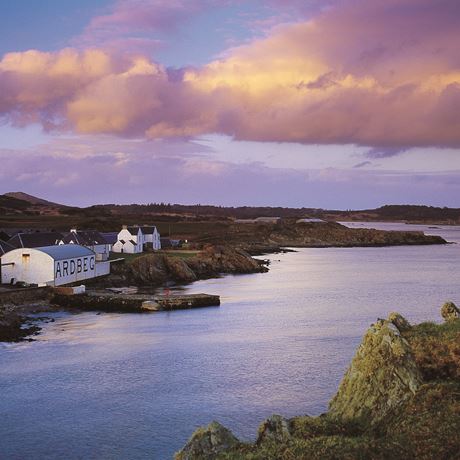
ARDBEG HISTORYImage

By the end of the 19th century, Ardbeg had become a valued fixture on Islay’s southern coast. Founded in 1815 by the McDougall family, the site had grown into a small community with housing, a hall, greenhouses, a bowling green and a school for 100 pupils. The reason for its success was tied to the growing popularity of blends and the need for most to have some smoke running through them.

When the combination of war and iconic depression hit the blended market in the 1920s however it – like most distilleries – was finding the going tough. It wasn’t to be the last time. The Hay family, which had taken the licence in 1853, steered it back to profitability before the distillery was bought by DCL and Canada’s Hiram Walker in 1959.

A rise in demand for peated whisky saw production increase in the 1960s and 70s, with demand necessitating that the distillery bring in peated malt from Port Ellen from 1974. For aficionados the end of Ardbeg’s self-sufficiency was the end of an era – and a style. Seven years later, Ardbeg’s kiln was finally extinguished.

The Canadian distiller took full control in 1979 buying out DCL’s 50% share for £300,000. By that time, blends were once again on the slide and to compensate for the drop in demand for smoky malt an unpeated make [Kildalton] began to be produced.

In 1981 the distillery was mothballed but restarted again in 1989, albeit on an intermittent basis, by which time it had joined Laphroaig in the Allied Distillers stable.

In 1996, it was silent once more, but saved a year later by Glenmorangie which paid £7m for the distillery and stock – or what there was of it. By this time, Ardbeg had built its reputation as one of the cult single malts. Glenmorangie’s task therefore was both to manage expectations, eke out the remaining stock, and start recreating the brand. In an inspired move they also invested in a visitor’s centre and cafe (for years pretty much the only place to eat in the south of Islay).

The stock profile meant that its first age statement release was a 17-year-old, while it would take until 2000 for its own Ardbeg 10-year-old to appear. From 2004 however there had been incremental releases, ’Very Young’, ‘Still Young’ and ‘Almost There’ showing the work in progress.

The portfolio still concentrates on no-age-statement releases, some exclusively from (now very rare) old stock, others from new, some from a mix. Different oaks have also been used as part of a general improvement in the quality of casks used.

Despite demand continuing to rise, Ardbeg will remain small and will remain a cult – albeit one with a global community, ‘The Committee’ numbering in excess of 120,000 people.

Image result for ardbeg corryvreckan

Tasting Notes

Nose: burning tire, sweet smoke, molasses, tires, old horse patties
Taste: surprisingly sweet, earthy, hint of something savoury, sea salt, iodine, pastries, cinnamon bun
Finish: slight bitterness, burnt brown sugar, sesame, molasses

Purchase Links

Can be purchased here from Legacy Liquor

Day 16 — Canadian Rockies 21

Welcome to day 16. We got ourselves second of my little surprises. I figured you might be getting a little tired of regular whisky and so today we a nice little 21 year old corn whiskey. Do not be fooled by your preconcived notions about Canadian blends though this one has a story and we promise its a good one

Story

It has been about five years since Vancouver’s Fountana Group launched their Canadian Rockies line with a tasty 21-year-old corn whisky from Highwood Distillers in High River, Alberta. The whisky was intended for the Asian market, and bore a number of flavour markers that would appeal to a palate familiar with Asian fruits.

Word spread and soon Canadian whisky fans were asking for the whisky to be released in Canada as well. Thomas Chen, Fountana’s manager in charge of whisky tweaked the cask selection and boosted the abv to 46% for Canadian release. It was a huge success.

Enter Roberto Roberti, a long-experienced whisky distributor. Shortly after Roberti joined the Fountana Group, Chen put him in charge of the Canadian Rockies brand. Roberti had a vision for a Canadian whisky that would appeal to connoisseurs and also to visitors and gift givers.

The label still says 21 years old, but the blend includes some whisky that is significantly older and that really boosts the elegant woody notes. Roberti also commissioned a custom bottle, embossed with the rocky mountains, with one peak punching right up into the bottle from underneath.

And finally he added his trademark Canadian maple leaf to the label. Roberti remembered when he was the agent selling Canadian Club to duty free stores. Sales soared after he added a tiny red maple leaf to the labels.

Canadian Rockies 21 year old is big whisky with plenty of breadth and depth, yet it retains the refined elegance of long-aged Canadian whisky.


Image result for Canadian Rockies 21

Tasting Notes

Nose: Buttery sweet corn with lively hot pepper and sweet rye spices.
Taste: Black tea,dark fruits, peppery heat, dark licorice
FInish: Clean wood, fading pepper, hints of citrus fruit , slightly sweet fruity notes, mild grapefruit pith.

Purchase Links

Can be purchased at Strathcona Liquor 

or 

Can be purchased here Legacy Liquor

Day 15 — Kilchoman 2007 KWM 25th Annv. 10 Year

Day 15! If you have made it this far and you enjoy peat this is going to be a good day for you. We somehow managed to get a hold of a couple of the Kensington Wine Markets exclusive bottling  of Kilchoman. It is the first 10 Year Old Kilchoman to be sold in Canada! Bottled at 56.6% after maturing in an Ex-Bourbon barrel. There were just 212 bottles. I do hope you enjoy.

KILCHOMAN DISTILLERY

ISLAY SINGLE MALT SCOTCH WHISKY

These days 25% of its barley requirements come from Islay (mostly from fields around the distillery). It has a small malting floor and kiln which produces a medium-peated malt – the heavily peated with which it is mixed comes from Port Ellen. Inside the distillery, fermentation is long – helping to create fruitiness to balance the shoreline/shellfish like phenolics, while an enlightened (and pricey) wood policy has seen a high percent of first-fill ex-Bourbon and ex-Sherry casks being used. The result is that Kilchoman has hit the start of its mature period at a remarkably young age.

KILCHOMAN HISTORY

The location of Kilchoman on Islay’s west coast has some historical resonance. It was in this parish that the MacBeatha/Beaton family settled when they came across in 1300 from what is now Co. Antrim. They were doctors (a Beaton was the hereditary physician to the kings of Scotland for hundreds of years) who translated medical texts about distillation from Latin into Gaelic.  There is therefore a theory (albeit unproven) that Islay was the first place where distillation took place in Scotland – and that Kilchoman parish was where it occurred.

It wasn’t so much this which caused Anthony Wills to build his farm distillery here in 2005 – it was more the fact that there was a spare steading at Rockside farm available. In building Kilchoman, the Wills family has brought farm distilling back to Islay.

Now surrounded by barley fields, the distillery has expanded once (in 2007) built new warehouses and in 2010 hired a hugely experienced manager in John MacLellan who had spent many years at the helm of Bunnahabhain. The history may be short, but the long-term vision is very much in evidence.

Tasting Notes

Nose: gentle smoke, green apple,sour keys,Smoldering fire,medicinal
Taste: friendly campfire, candied bacon,cream,nutmeg, cardamon
Finish: more campfire, burnt marshmallow,good,lingering smoked bacon,

Day 14 — Deanston 12

Welcome to day 14. Today we bring in a tasty offering from the Deanston distillery. I don’t have much to say about this whisky other than I enjoyed it so tuck in then read the write up below and enjoy

Deanston distillery

Deanston distillery is a Single malt Scotch whisky distillery located on the banks of the River Teith, eight miles from the historic town of Stirling, at the gateway to the dramatic Loch Lomond & Trossachs National Park. It is the largest distillery owned by Scotch whisky producer Distell Group Limited, who also own Bunnahabhain Distillery on the Isle of Islay and Tobermory distillery on the Isle of Mull.

Deanston Distillery started life in 1785 as a cotton mill designed by Sir Richard Arkwright, and remained as such for 180 years until it was transformed into a distillery in 1966. The constant supply of pure water from the River Teith contributed to the decision to turn the mill into a distillery and Deanston is now the only distillery in Scotland to be self-sufficient in electricity, with power generated by an on-site hydro-energy facility. Deanston sits in the Highland single malt region of Scotland and produces whisky which is handmade by ten local craftsmen, un-chill filtered, natural colour and bottled at a strength of 46.3% ABV.

DEANSTON HISTORY

There are many distilleries in Scotland which started life as mills, but none of them had quite the scale of Deanston. This huge plant was constructed on the banks of the fast-flowing River Teith in 1785 by Richard Arkwright who used it as one of the sites for the development of the Spinning Jenny. It also had what was claimed to be the largest water wheel in Europe.

Weaving continued here until 1964 when the buildings were bought by Brodie Hepburn. Production started in 1969, but its original owners only had it for three years before the company was bought by private label specialist Invergordon. It ran for a decade before the 80s whisky slump forced its owner to shut it down. Eight years later, it was bought for £2.1m by Burn Stewart.

It can claim to be one of the greenest distilleries in Scotland. All of its power is generated by a turbine house which processes 20 million litres of water an hour. The excess electricity is then sold to the National Grid.

Although single malt bottlings started relatively early – in 1974 – it is only recently that Deanston has been elevated to a front-line single malt brand.


Image result for deanston 12

Tasting Notes

Nose:  baked apple pie with a healthy dose of cinnamon, dried apricots, mango salsa, Midori melon liqueur.
Taste: fruity, floral and malty; waxy and honeyed with loads of vanilla, more dried apricots and baked apple and cinnamon pie in a very buttery crust
FInish: honeyed, fruity and toasty

Purchase Links

Can be purchased here from Legacy Liquor

or

Can be purchased here from BC Liquor Stores